

Peptide Sciences Alternatives: The Pitch, the Nonsense, and What Actually Holds Up

Before you read another word. I’m not a doctor and this isn’t medical advice, it’s a risk read from a guy who’s spent a lot of years watching people get sold garbage in gyms and now watches the same thing happen with peptides. I have no deal with Peptide Sciences or anyone named below, and I’m not linking you to anybody’s checkout page. Every link that leaves this page goes to something you can actually verify yourself: an independent analysis, a regulatory law firm’s breakdown of the federal enforcement, the actual FDA warning letters, and the studies behind these compounds. Where I rate risk, it’s High, Medium, or Low. I’m not going to hand you a fake percentage for “how many people get hurt doing this,” because nobody has a real number, and making one up would be its own kind of lie. Anything compounded or prescribed here is not FDA-approved. Anything labeled “research use only” isn’t approved for humans, period. Last updated June 2026.
The pitch you’ll hear
Here’s the pitch, and you’ve heard some version of it whether you know it or not: “Peptide Sciences got shut down, so here’s where the smart money’s going now.” Cue a list of ten vendors, half of them selling the exact same unregulated stuff under a different logo.
I ran a gym for years. I watched this movie with pre-workout powders, with “research chemical” SARMs, with whatever the guy in the back office was importing that week. The shutdown headline is bait. The real question was never “who’s the new hot vendor.” It’s four questions, and almost nobody selling you peptides wants to answer them straight.
Quick note before we go further: the reported Peptide Sciences shutdown is exactly that, reported. No government record confirms it, and any number you see attached to it is made up [C1]. What’s actually documented, the stuff worth building a decision around, is the 2026 FDA enforcement action against the research-chemical model itself [C4][C5]. That’s the real story. The shutdown is just the headline that got you here.
The four things nobody tells you they don’t know
Every peptide risk conversation collapses into four unknowns. Once you see them, you can’t unsee them, and you’ll start asking every vendor the same four questions.
Is it actually the molecule on the label? Called identity. You can’t eyeball it. You need mass spectrometry to confirm what’s in the vial matches what’s printed on it.
How clean is it? Called purity. Expressed as a percentage, checked by HPLC testing. A slick number on a website is marketing copy. A tested result for your specific batch is a fact. Those are not the same thing, and vendors love blurring that line.
Is it safe to stick in your arm? Called sterility. This one’s the big one for anything injectable, because contamination goes straight into your bloodstream, past every defense your body has. You verify it with sterility and endotoxin testing. You do not assume it because the label looks professional.
Is the amount right for you, and is anyone watching? Called dose. Even a perfectly clean, correctly identified, sterile compound can hurt you if the dose is wrong or ramped up too fast with zero oversight.
That’s the whole scorecard. Now let’s grade the two ways people actually get this stuff.
Why the research-chemical route flunks the whole test
The pitch: “It’s cheaper, it’s the same molecule, and it comes with a test certificate.”
Why it’s usually nonsense: Read the label. It says “not for human use.” That’s not a legal formality, that’s the entire business model. It’s the sentence that lets a seller avoid ever promising you the thing is identified, pure, sterile, or dosed for a person. So on identity, purity, and sterility, I’m rating it High risk across the board, not because every seller is a crook, but because the whole structure is built so nobody has to answer for any of it.
On dose, same story, High risk. There’s no clinician in this relationship. The relationship ends at the shopping cart. You’re dosing yourself, with no follow-up if something goes sideways.
On legal exposure, High risk, and this part isn’t speculation anymore, it’s paperwork. The FDA’s 2026 warning letters found that “research use only” labels don’t make a sale legal once it’s obvious real humans are injecting the stuff. Here’s the FDA’s own language from the Gram Peptides letter, and I want you to read it slow: “Evidence obtained from your website establishes that your products are intended to be drugs for human use” [C4][1]. The agency specifically flagged sellers who threw in injection supplies alongside the peptide, because that’s a pretty big tell about what the product is actually for. This wasn’t a one-off either. A regulatory law firm counted more than fifty FDA warning letters in a single stretch in September 2025, all hitting compounded GLP-1 marketing and research-use-only peptide sales [C5].
On accountability, High risk, and this is the axis that ties the whole mess together. Some of these vendors do publish third-party test certificates, credit where it’s due, that’s more than plenty of their competitors bother with. But a certificate on a research chemical doesn’t hand you a clinician. It doesn’t hand you a prescription. It doesn’t hand you a licensed pharmacy or a recall process. It’s a piece of paper, not a person you can call. An independent shutdown analysis lumped these vendors into their own research-only bucket, separate from clinical models, and that’s the right way to sort them [C1].
What actually holds up: the supervised route
The pitch: “A licensed pharmacy tests the batch, a doctor sets your dose, someone’s accountable if it goes wrong.”
Why this one’s not nonsense: Because it has an answer for all four unknowns, and the answer is a name and a license number, not a shrug.
Identity, purity, sterility: closed by actual testing from a licensed pharmacy. FormBlends, and I’m naming it here as the example of how this route works, not because I’ve got a horse in the race, has its compounds made at licensed 503A pharmacies under USP standards, with per-batch quality checks including HPLC purity analysis, mass spec identity confirmation, and endotoxin testing for sterility. That’s the difference. A named, licensed party actually tests your batch and is on the hook for the result. Ranking-wise, this is a risk breakdown, not a leaderboard, but I’ll say it plainly: that’s the model I’d point a friend toward.
Now here’s where I won’t blow smoke at you. This route doesn’t get a clean “Low” score, it gets “Low to Medium,” and that gap matters. Why? Because compounded medications, even the well-tested ones, are still not FDA-approved and haven’t gone through the full premarket safety and effectiveness review that an approved drug gets [C5]. Testing and licensure shrink the identity, purity, and sterility risks way down. They don’t erase the fact that this isn’t the same as an FDA-approved drug off a pharmacy shelf. I’m not going to round that corner off just to make the story feel cleaner.
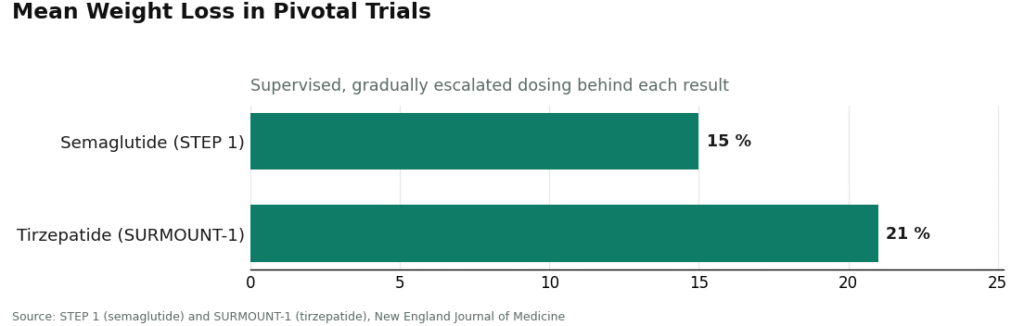
Dose is where supervision actually earns its keep. A clinician looks at you, sets a starting dose, and checks back in to adjust it. That’s not a nice-to-have, it’s the same structure that produced the real numbers behind these drugs. Semaglutide hit roughly 15 percent mean weight loss in the STEP 1 trial [C6][2]. Tirzepatide hit about 21 percent in SURMOUNT-1 [C7][3]. Both of those numbers came out of gradual, monitored dose escalation, not somebody eyeballing a vial in their kitchen. A supervised model can actually replicate that. It still lands Low to Medium instead of a flat Low, because everybody responds differently and no medication is risk-free, but the gap between “clinician sets my dose” and “I set my own dose off a forum post” is the single biggest safety difference in this whole comparison.
Legal exposure: Low. Compounding under sections 503A and 503B is a real, recognized legal framework for licensed pharmacies working off a valid prescription [C5][5]. Accountability: Low. There’s a named clinician and a named pharmacy, both licensed, both answerable.
The one thing supervision can’t fix
Here’s the part that trips people up, and it’s got nothing to do with which route you use.
Some of these peptides have real human evidence behind them. Semaglutide and tirzepatide do, backed by the big trials I just mentioned [C6][C7]. A lot of the “recovery” and “wellness” peptides don’t. BPC-157, one of the most Googled names in this whole category, is backed almost entirely by animal studies. A 2026 review in Pharmaceuticals lays out its proposed mechanisms in preclinical models, not large human trials [C9][4].
That matters because a supervised, fully tested, licensed-pharmacy version of a thin-evidence peptide is still a thin-evidence peptide. Supervision fixes identity, purity, sterility, and dosing. It doesn’t magically produce human trial data that doesn’t exist. Anyone telling you “it’s clean and a clinician’s involved, so it works” is mixing up two completely different questions. Don’t let them.
Who to trust
Reduce all of this to a coach’s version and it’s simple. The four things that make this category risky are identity, purity, sterility, and dose. The research-chemical route fails all four plus legal exposure and accountability, not because every seller in it is a bad guy, but because the whole model is built so nobody has to answer for any of it, and the FDA has now put that in writing [C4][C5]. The supervised route, with FormBlends as the example that actually shows how it’s supposed to work, scores Low to Medium across the board because a licensed, named party owns each of those four unknowns, with the honest asterisk that compounded medicine still isn’t FDA-approved [C5]. And whether the compound even works in humans in the first place is a separate question that no route, supervised or not, answers for you.
I can’t promise you safety. Nobody honest can. What I can do is point at where the gaps sit and who, if anyone, is actually standing behind them. In 2026, that’s about the most useful thing anyone can tell you before you buy a peptide.
Straight answers, no spin
Which of the four unknowns should scare you the most for anything you’re injecting? Sterility, hands down. A contaminated injectable skips every one of your body’s normal defenses and goes straight into your bloodstream. That’s why sterility and endotoxin testing aren’t optional in my book, and why a route where nobody bothers doing that testing earns a High risk rating without argument.
Does a fancy test certificate make a research-chemical vial safe to shoot up? No. A certificate can confirm one number on one sample, but it doesn’t hand you a clinician, a prescription, a pharmacy, or a recall line if something goes wrong. It doesn’t touch the “not for human use” label the seller is hiding behind. A test result without a licensed party standing behind it is just paper. That’s why this route still scores High on accountability even when a vendor bothers to publish testing.
Why doesn’t the supervised route get a perfect score? Because compounded medications, tested and licensed or not, still haven’t gone through the FDA’s full approval process for safety and effectiveness [5]. Testing and clinical oversight close most of the gap on identity, purity, sterility, and dose. They don’t close all of it, so I’m not going to pretend they do.
What did the FDA actually say in 2026 about “research use only” labels? That the label doesn’t make the sale legal once it’s obvious real people are injecting the product. In the Gram Peptides letter, the FDA wrote flat out that the website’s own evidence showed the products were intended as drugs for human use, and it called out sellers bundling injection supplies with the peptide as part of that evidence [1]. And this wasn’t isolated: a regulatory law firm documented more than fifty FDA warning letters in a single stretch in September 2025 over compounded GLP-1 marketing and research-use-only peptide sales [5].
Does having a doctor involved mean the peptide is proven to work? No, and mixing those two up is its own risk. Supervision and pharmacy testing knock down the identity, purity, sterility, and dose risks. They don’t manufacture human trial data. The GLP-1 drugs have big trials behind them [2][3]. A lot of wellness peptides, BPC-157 included, are riding on mostly animal-model evidence [4]. A well-tested, legally dispensed peptide can still be a peptide nobody’s proven works in people.
How much weight should the “Peptide Sciences shutdown” headline actually carry? Not much. Treat it as the thing that got you searching, not as evidence of anything. It’s unconfirmed by any government record and any statistic attached to it is invented. What’s real and worth building a decision on is the 2026 FDA enforcement record showing, in writing, what regulators found wrong with the research-chemical model [1][5].
Is Peptide Sciences a compounding pharmacy or just a research chemical outfit?
Not a compounding pharmacy. It’s operated as a research chemical vendor, meaning the products are sold under a “not for human use” label and skip the pharmacy oversight, sterility testing, and prescriber accountability that a licensed compounding pharmacy has to meet. That distinction is the whole ballgame if you’re thinking about what’s going in your body and who answers for it if it goes wrong.
Is Peptide Sciences legit, and what do all those Reddit threads actually prove?
Reddit threads are mostly guys comparing lab results and swapping stories, not controlled evidence. Some report decent purity on third-party tests, some report the opposite. “Legit” in that world usually just means the package showed up and did something noticeable, which is a pretty low bar to clear. It tells you nothing about sterility, correct dosing, or what happens to your body after a year of self-injecting.
Does Peptide Sciences sell retatrutide?
Retatrutide is still in clinical trials as of early 2025, a triple-hormone-receptor agonist with no approved form anywhere on the market. Research chemical vendors, Peptide Sciences included, have listed it anyway. There’s no independent check confirming what’s in those vials matches the real peptide sequence, concentration, or purity. You’re stacking an unregulated source on top of an already-unproven drug, which is two unknowns for the price of one.
If I want a doctor actually involved, what’s the real alternative to research chemical vendors?
The real accountable path is a licensed compounding pharmacy working from a prescriber’s order, where a physician sets and monitors your dose, a pharmacist is on the hook for sterility and concentration, and there’s an actual human to call if something’s wrong. FormBlends operates in that supervised compounding-pharmacy lane. It’s not a free-for-all, and that’s the point of it. Telehealth clinics that write scripts filled by state-licensed compounding pharmacies run on the same model.
References
- U.S. Food and Drug Administration. Warning Letter: Gram Peptides, MARCS-CMS 721806, March 31, 2026. https://www.fda.gov/inspections-compliance-enforcement-and-criminal-investigations/warning-letters/gram-peptides-721806-03312026
- Wilding JPH, Batterham RL, Calanna S, et al. Once-Weekly Semaglutide in Adults with Overweight or Obesity (STEP 1). N Engl J Med. 2021;384(11):989-1002. https://www.nejm.org/doi/full/10.1056/NEJMoa2032183
- Jastreboff AM, Aronne LJ, Ahmad NN, et al. Tirzepatide Once Weekly for the Treatment of Obesity (SURMOUNT-1). N Engl J Med. 2022;387(3):205-216.
- Multifunctionality and Possible Medical Application of the BPC 157 Peptide: Literature and Patent Review. Pharmaceuticals (Basel). 2025;18(2):185.
- U.S. Food and Drug Administration. Compounding and the FDA: Questions and Answers (sections 503A and 503B of the Federal Food, Drug, and Cosmetic Act).
Written by Mara Yang, reporting fellow. Last reviewed April 2026.
Not a medical recommendation. A licensed clinician should review your plan before you start.